- Every company already has a company brain: decisions, rules, project state, exceptions, and next steps. The problem is where it lives.
- Claude Tag makes that memory shared and multiplayer: when the whole team uses the same assistant, operating state is no longer optional.
- The decisive question is ownership: does that context stay inside a vendor, or on files you can read, govern, and take with you?
- Yempik’s answer is already public: cowork-os for the business, code-os for the code. Same method, operating context on files you own.
What Anthropic launched, plainly
Claude Tag brings Claude into the company’s Slack channels: you tag it, delegate a task, and it works using tools, data, and shared context, remembering relevant channel information instead of starting from zero on every request[1]. Early coverage sums it up like this: it’s learning how your company works, one message at a time[2].
There’s also a governance boundary already stated: administrators choose which channels, tools, and information Claude can access; memories stay scoped to configured channels, while in direct messages Claude responds privately using personal tools and connectors[1].
The feature is useful. That is exactly why it deserves scrutiny: when AI starts remembering how the company works, you are no longer choosing only an assistant. You are choosing where to put operating memory.
It’s not memory. It’s multiplayer.
Memory alone isn’t the new part: models already remember something between sessions. The new part is that the same Claude now enters the work of a whole team. The moment five people tag the same assistant, shared operating state stops being a luxury and becomes a requirement. Without common context, the same Claude answers every colleague differently, because each one feeds it disconnected pieces of the truth.
One person can keep the plan in their head. A team can’t. You need a place where “how we work” is written down, shared, and re-read by everyone, people and AI.
An assistant becomes useful to a team only when it reads the same context the team reads. Otherwise it isn’t a teammate: it’s five different assistants with the same name.
Where the company brain lives, and who owns it
We call “company brain” the set of things a team needs to know in order to work: decisions made, project status, open questions, rules, next steps. As long as it lives in people’s heads and in chats, it doesn’t scale. When you put it inside an AI, it scales. But at that point the question is no longer technical, it’s about ownership: is that brain yours, or is it rented?
Two axes change everything. The first: where the data lives, inside a vendor’s infrastructure or in a place you control. The second: how it’s governed, automatically and opaquely or explicitly and auditably. The combination of the two tells you who really owns your company brain.
Vendor memory, or context on files you own
It’s not a holy war: they’re two approaches with different trade-offs. Automatic vendor memory is convenient and zero-setup, but it’s opaque (you can’t see what it learned), it lives where the vendor decides, and if you switch tools you leave it behind. Context on files you own takes a bit of discipline, but it’s readable, versionable, auditable, and it moves with you.
| Dimension | Vendor memory | Context on files (cowork-os and code-os) |
|---|---|---|
| Where it lives | Inside the vendor’s tool | On files, in your own space |
| Who owns it | The vendor | You |
| Governance and audit | Opaque: you can’t see what it learned | Explicit: readable and auditable |
| Relationship with your tools | Closed: you live inside its walls | Sits on top and connects them (Notion, Drive, chat) |
| If you switch tools | It stays behind | It moves with you |
| Shared state across the team | Per channel, inside the chat | One source the team and AI re-read |
| Initial setup | Zero: works right away | A bit of upfront discipline |
For anyone in a regulated industry, handling sensitive data, or who knows tools will change, the difference isn’t a detail: it’s the difference between an opaque memory and governed work. It’s the same reasoning as our guide on AI governance for SMEs: you can’t govern what you can’t see.
The company brain you own: cowork-os and code-os
Our answer did not start after the Claude Tag launch: we’ve been building it for months, and it’s public. cowork-os is the open-source kit in which we package our method for people who work with the business: folder structure, instructions, automations, and the work-state update rule, so the company’s context sits in one place, on your computer, readable by you and by Claude[3]. code-os is the same idea for people who write code: operating context and best practices on files, drop-in to any codebase[4]. Two faces of the same method: explicit operating context, on files that stay yours.
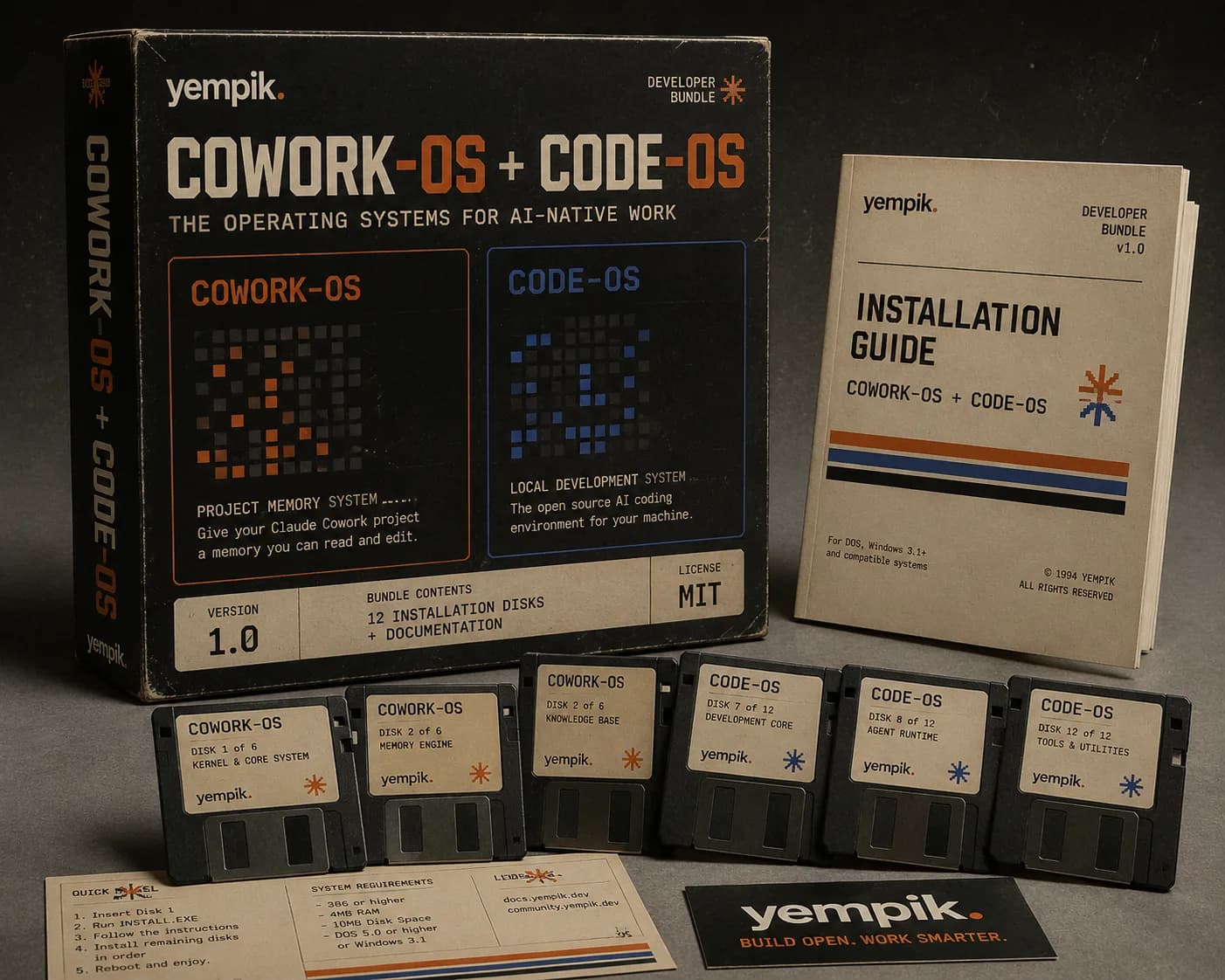
cowork-os
People who work with the business, without coding
The folder structure, the instructions, the automations, and the work-state update rule: your company’s context in one place, inside Claude Cowork.
cowork-os on GitHubcode-os
People who write code
The same method for the codebase: operating context and best practices on files, drop-in to any project. Technical decisions stay written down and yours.
code-os on GitHubIt’s the difference we care about. AI becomes useful when it sits where work actually happens, but it stays governable only when the context is readable and yours. Claude Tag makes this method more relevant, not less: the more AI enters teams, the more it matters to have context that’s yours.
Plus the instructions, the routine automations, and a real, already filled-in example to copy from.
When the vendor is enough, when you need to own it
If you’re a small team, you already work entirely in Slack, and you want speed with no fuss, the automatic memory of a tool like Claude Tag can be more than enough. There’s nothing to configure and it works. Saying so is part of our method: if the vendor’s AI is enough for you, we won’t sell you complexity.
Owned, governed context matters when at least one of these is true: you operate in a regulated industry or with sensitive data, you need to know and prove what the AI learned, you work with multiple tools and don’t want to be locked into one, or you want the know-how to stay in the company even when people change. There, an opaque memory inside a vendor isn’t enough anymore.
Five questions to know who owns your company brain
You don’t need to switch tools to start. You need to know where you stand. Answer these five questions about your current AI assistant.
If you want a sharper picture, take the self-check and find out what level your company brain is at.
- 1Portability
If you switch tools tomorrow, does the context move with you?
- 2Transparency
Can you see and edit what the AI knows about your company?
- 3Single source
Is there one place where decisions and state are written down?
- 4Control
Do you know who has access to that context and who governs it?
- 5Continuity
Does the know-how stay in the company if a person leaves?
If you answer “I don’t know” or “it’s inside the tool” to more than one, your company brain is rented.
Company brain, in practice
Does Claude Tag replace cowork-os?
No, they solve different things. Claude Tag brings Claude into Slack conversations with its own memory. cowork-os defines where your company’s operating context lives, on files you own and govern, independent of the tool. They can be used together: the tool reads context that stays yours.
Who owns the context when I use Claude Tag?
It depends on where you work. Anthropic attributes work in channels to the organization’s identity and work in direct messages to your personal account, and an Owner configures access. The memory, though, lives inside the tool: if you switch tools, it doesn’t move with you.
What is a “company brain”?
It’s the set of things a team needs to know in order to work: decisions, project status, open questions, rules, next steps. It becomes useful when it’s written in one place, readable by both people and the AI, instead of staying scattered across heads and chats.
What’s the difference between cowork-os and code-os?
Same method, two audiences. cowork-os is for people who work with the business and don’t code: it organizes the company’s context inside Claude Cowork. code-os is for people who write code: it brings operating context and best practices on files into any codebase. Both keep the context on files that stay yours.
Is it risky to put my company’s memory inside a vendor?
It’s not risky in itself, it depends on the context. For many teams it’s fine. It becomes a problem when you operate in a regulated industry, handle sensitive data, need to prove what the AI learned, or want the know-how to stay if you change tools or people. In those cases, context you own and govern is the better choice.
Sources
- [1]Anthropic, “Introducing Claude Tag”, June 23, 2026. www.anthropic.com
- [2]TechCrunch, “Anthropic’s Claude Tag is learning your company, one Slack message at a time”, June 23, 2026. techcrunch.com
- [3]cowork-os, open-source repository. github.com
- [4]code-os, open-source repository. github.com
This article is written by Raffaele Zarrelli and Simone Bova, founders of Yempik. The editing is done with Claude. The tools cited and shown are our open-source kits cowork-os and code-os and Claude Cowork. Where we cite facts or numbers, you’ll find the source below.
Want to know if your company brain is yours or rented?
We start from your process, not the tool. We help you put context on files you own, governed, and bring automations into production when do-it-yourself isn’t enough. Fixed price and timeline, the code is yours.