
Every chat is a silo
Conversations live in personal accounts. What Sara decided with ChatGPT, Marco will never see.
Scattered knowledgeYempik turns it into trusted company context for every agent.
Connect unlimited agents. Free. Forever.

Pricing decision
From GTM review

New onboarding step
From CS handoff
Decision
Launch pricing at $59/month
Process
Client onboarding: 3-step flow
ICP
Focus mid-market B2B SaaS
Needs review
Weekly pipeline review
ChatGPT
Synced
Claude
Synced
Cursor
Synced
Codex
Synced
Yempik MCP connects to the AI clients your team opens every morning. No extra app to learn: company knowledge arrives right where you already work.
Some brainstorm on ChatGPT, some build with Codex or Cursor, some prepare reports with Claude. Every chat creates value and the company sees almost none of it. And none of these AIs lifts a finger until someone asks.
Conversations live in personal accounts. What Sara decided with ChatGPT, Marco will never see.
Scattered knowledgePrice list, clients, rules: every new chat starts from zero, and everyone re-explains the company to their own AI.
Time lost every dayEach AI answers with whatever it knows: old versions of the price list, outdated decisions, invented sources.
Operational riskDecisions and solutions stay in the chats of whoever wrote them. When a person leaves, that knowledge leaves too.
Continuity at riskThe Company Brain is your company’s operating knowledge in one place: decisions, processes, rules, clients, and glossary, versioned and always with the source shown. People consult it, the team’s AI tools work on top of it via Yempik MCP, and the system uses it to prepare your work: never to execute it on its own.
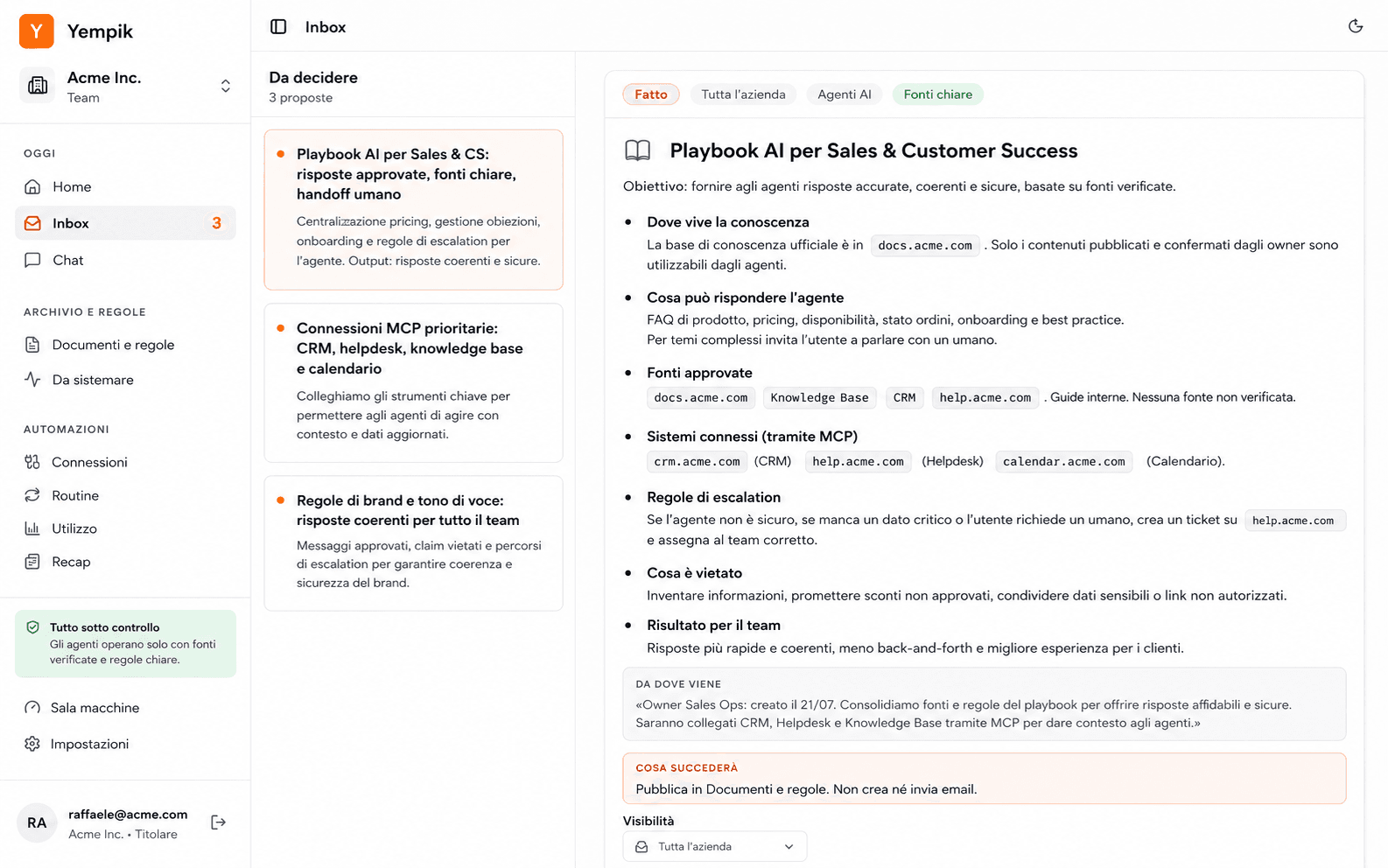
The Brain doesn’t wait for your questions: it crosses what happens (email, chat, calendar) with your company’s rules and puts ready-made proposals in your Inbox. Approve, edit, or reject; it learns from every choice you make.
Default: it proposes, you approve. No email goes out on its own, no truth writes itself; autonomy climbs step by step, routine by routine, only with the trust it earns.
A lead writes asking for a quote
In your Inbox: the reply draft, anchored to the active price list. Read it, approve it, it goes out.
The chat settles the discount for public-sector clients
At 3:00 PM you have the Huck May Inc. call
A deal has been sitting still for over 48 hours
Connect Yempik MCP once; from that moment, every AI on the team works from your company’s verified knowledge and contributes to the Brain as it works, without being asked.
Ok, closed with Bianchi: for public-sector clients the maximum discount is 12%, not 15.
Updating the Brain:
I proposed the revision to the price-list decision, without being asked. Once you approve it, it holds for every AI on the team.
When a decision, rule, or fact that matters emerges in chat, the AI proposes it to the Brain on its own. Capturing is the default behavior, not a command.
brain_propose_itemOn price lists, clients, and procedures the AI queries the Brain and answers with the current decision, never a superseded version. Source cited, always.
brain_search · brain_get_current_decisionFrom chat, the AI can also propose routines: monitors, prep, follow-ups. Every proposal goes through the Inbox before it runs.
routine_proposeOAuth connection, per-user permissions, an audit trail for every call. Everyone sees only what they’re allowed to see.
OAuth 2.1 · audit logEach person connects their AI once. One URL, one login, and the chat works on your Company Brain.
Choose your AI
Copy the endpoint and use it in any MCP client.
https://mcp.yempik.ai/mcpIn Claude, open Settings · Connectors, choose “Add connector”, and paste the MCP endpoint.
At login, pick the workspace. From then on the chat works only on that Brain.
No migration, no new platform to learn: you start from the knowledge you already have and the AI tools you already use.
we seed the Brain with you: decisions, price lists, processes, and clients, from the knowledge you already have.
each person connects Yempik MCP to their own AI: ChatGPT, Claude, Codex, or Cursor.
chats read the Brain, cite sources, and propose updates as you work.
every proposal passes through you: approve, edit, or reject it. Proposal first, truth second.
No chat writes directly to the Brain, and nothing happens on its own: every change starts as a proposal, approved by a person, with a full audit trail. The format is open: the Brain stays in your own files, readable even without us. cowork-os on GitHub ↗
One single truth for people and AI. Every answer gets better, every decision sticks.
The team’s AI tools answer only with verified company knowledge, and every answer shows where it comes from.
Price list, clients, and rules are already in the Brain: every chat starts informed, on any tool.
Tracked proposals, clear permissions, human approval on everything. The team adopts it because it doesn’t change their habits.
Start free. Connect agents whenever you want. No credit card required.
Connect unlimited agents. Free. Forever. One price per workspace — never per seat.
$0/mo
For solo professionals and businesses. Business use only. No credit card required.
Start free$59/mo
The public plan for teams: one shared brain, up to 5 people.
Start with Team$179/mo
For larger teams: internal agents, routines, and advanced automations.
Start with ScaleIt’s your company’s operating knowledge in one place: decisions, processes, rules, and clients, versioned and with the source shown. People consult it; the team’s AI tools use it via Yempik MCP to answer and propose updates. Unlike a wiki, it stays alive, because it updates from everyday work.
That memory is personal and closed: it lives in one person’s account, inside a single tool, and you don’t govern it. The Company Brain belongs to the company: shared across people and across different AI tools, with versions, sources, and human approval. And if you switch tools down the road, the Brain stays: your own files, exportable.
A wiki is written for humans who read pages. Agents don’t read pages: they call tools. The Brain serves both: people consult it, agents query it via MCP and get only approved, current truth with its source.
RAG retrieves the most similar text; it doesn’t know whether it’s approved, current, or permitted for whoever is asking. The Brain governs truth before retrieval: every change starts as a proposal, gets ratified and versioned. RAG gives you the most similar answer; the Brain gives you the correct one.
Agent 365 tells you which agents are running and whether they are safe. It does not tell you whether what they read is true. We sit on the knowledge side of that line: one approved source of company context, with a human approving what becomes truth, exportable and not tied to one vendor stack.
Those observe the traffic: what users ask and where agents fail. The Brain governs what the agent reads and answers. Complementary layers: one watches the sessions, the other guarantees the truth.
No. Yempik MCP connects to the AI clients you already use: ChatGPT, Claude, Codex, Cursor, and any MCP client. The team keeps working exactly where it works today.
No. Routines switch on by choosing outcomes in plain language: “don’t let my follow-ups slip”, “prep me before every call”. The system translates, watches how you work, and adapts; every correction you make refines it.
It can’t write to the Brain: it can only propose. Every proposal lands in the Inbox and becomes truth only if a person approves it. Answers cite the source, so you can verify it in one click.
You do. The Brain lives in readable files, exportable at any time, hosted in the EU. The format is open: it stays usable even without Yempik.
You can start free as a solo professional (Free: 1 member, no usage limits). Business use only — not for personal or household use. Team is $59/month ($39/month billed annually) per workspace up to 5 members, with automations and a shared workspace. Scale is $179/month up to 20, with internal agents, routines, and advanced automations. On every plan you can export the Brain anytime. You pay for the brain, not seats — connecting agents is free. For co-design, there’s Founding Design Partner by application.